
- The Python Collection module is defined as a container that is used to store collections of data, for example – list, dict, set, and tuple, etc.
- It was introduced to improve the functionalities of the built-in collection containers.
- Python collection module was first introduced in its 2.4 release.
- There are different types of collection modules which are as follows:
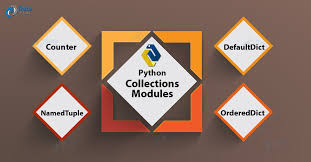
namedtuple()
The Python namedtuple() function returns a tuple like object with names for each position in the tuple. It was used to eliminate the problem of remembering the index of each field of a tuple object in ordinary tuples.
Example:
a= (‘Jan’,24, ‘F’)
print(a)
Output: >>(‘Jan’,24,’F’)
OrderedDict()
The Python OrderedDict() is similar to a dictionary object where keys maintain the order of insertion. If we try to insert key again, the previous value will be overwritten for that key.
Example:
import collections
dl=collections.OrderedDict()
dl[‘A]=10
dl[‘C]=12
dl[‘B]=11
dl[‘D]=13
for k,v in dl.items():
print(k,v)
Output: >>A 10 C 12 B 11 D 13
defaultdict()
The Python defaultdict() is defined as a dictionary like object. It is a subclass of the built-in dict class. It provides all methods provided by dictionary but takes the first argument as a default data type.
Example:
from collections import defaultdict
number= defaultdict(int)
number[‘one’]=1
number[‘two’]=2
print(number[‘three’])
Output: >>0
Counter()
The Python Counter is a subclass of dictionary object which helps to count hashable objects.
Example:
from collections import Counter
c=Counter()
list=[1,2,3,4,5,7,8,5,9,6.10]
Counter({1:5,2:4})
list=[1,2,4,7,5,1,6,7,9,1]
print(c[1])
Output: >> 3
deque()
The Python deque() is a double ended queue which allows us to add and remove elements from both the ends.
Example:
from collections import deque
list=[“x”,”y”,”z”]
deq=deque(list)
print(deq)
Output: >>deque([‘x’.’y’,’z’])
 TECHIE'S SCRIBBLING